Bluey Vuitton Magic Mushrooms: An Educational Overview of a Psilocybe cubensis Variety
Introduction
Bluey Vuitton Magic Mushrooms is a name used within mycological communities to describe a cultivated variety associated with the species Psilocybe cubensis. Like many named varieties, Bluey Vuitton represents a cultivated genetic lineage selected for particular inherited characteristics rather than a separately recognized scientific species.
This article is intended for educational purposes only. It explores the taxonomy, morphology, ecology, biology, and scientific significance of Bluey Vuitton Magic Mushrooms. It does not provide guidance on cultivation, consumption, or any activities that may be restricted by applicable laws.
Taxonomy
Bluey Vuitton belongs to the following scientific classification:
- Kingdom: Fungi
- Division: Basidiomycota
- Class: Agaricomycetes
- Order: Agaricales
- Family: Hymenogastraceae
- Genus: Psilocybe
- Species: Psilocybe cubensis
Although “Bluey Vuitton” is a recognized name within some mycological communities, it is considered a cultivated variety of Psilocybe cubensis rather than a distinct species. Cultivated varieties arise through selective breeding and inherited genetic variation while remaining members of the same biological species.
Background
The diversity of named Psilocybe cubensis varieties reflects the remarkable genetic variation found within fungi. Bluey Vuitton is one example of a cultivated lineage that has attracted attention because of its recognizable physical characteristics and its place within discussions of fungal genetics and morphology.
The naming of cultivated varieties is generally informal and community-based rather than part of official scientific taxonomy.
Physical Characteristics
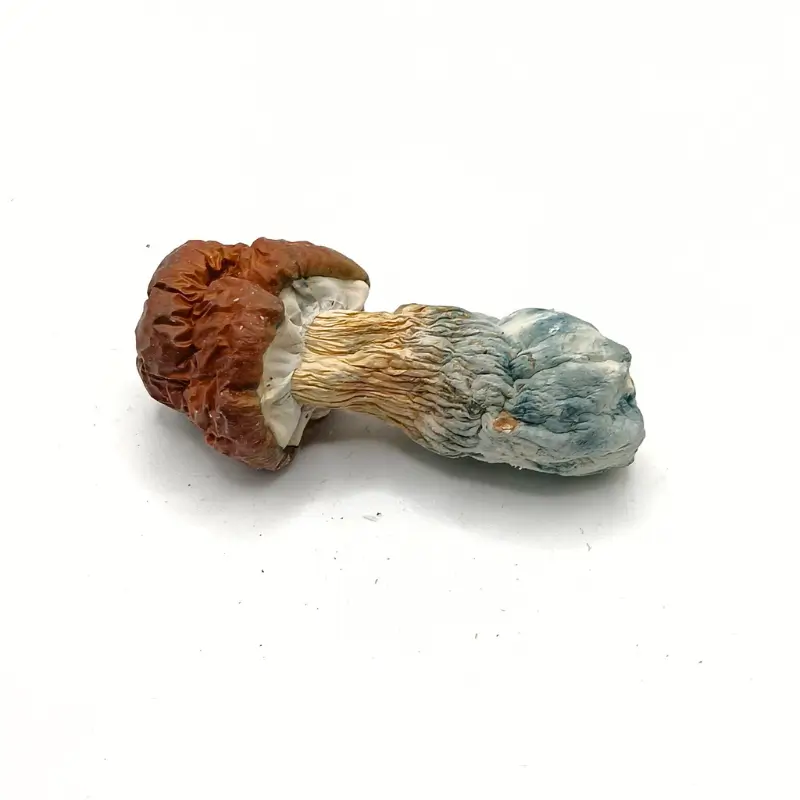
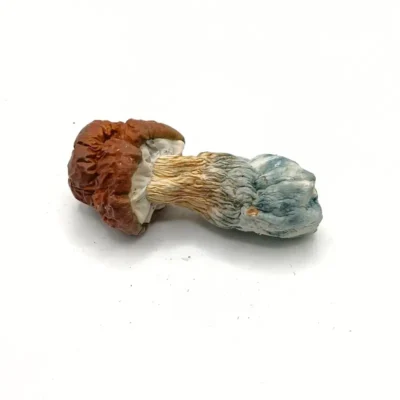
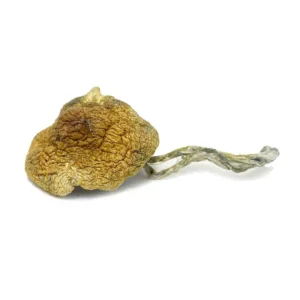
Bluey Vuitton Magic Mushrooms display many characteristics typical of Psilocybe cubensis. Individual mushrooms may vary in appearance depending on genetics and environmental conditions.
Common features include:
- Convex caps that gradually flatten with maturity
- Caps ranging from pale golden to caramel brown
- Thick white to cream-colored stems
- Purple-brown spores produced at maturity
- Blue bruising when mushroom tissue is damaged
- Firm, well-developed fruiting bodies
Natural variation is expected, and even mushrooms from the same lineage can differ in size, color, and shape.
Blue Bruising
Blue bruising is one of the most recognizable characteristics shared by many members of the genus Psilocybe.
When mushroom tissue is damaged, naturally occurring compounds undergo oxidation, resulting in a blue coloration. Scientists continue to investigate the biochemical pathways responsible for this reaction. Current evidence indicates that the intensity of blue bruising should not be interpreted as a direct measure of the concentration of naturally occurring compounds.
Ecology
Wild Psilocybe cubensis populations are typically associated with tropical and subtropical environments where warmth, moisture, and organic matter support fungal growth.
As decomposers, these fungi play an important ecological role by breaking down organic material and returning nutrients to the environment. Their underground mycelial networks contribute to soil formation, nutrient cycling, and the health of natural ecosystems.
Understanding these ecological functions helps illustrate the importance of fungi beyond their visible fruiting bodies.
Life Cycle
Like other mushroom-forming fungi, Psilocybe cubensis follows a complex reproductive cycle.
Microscopic spores germinate under suitable environmental conditions to produce thread-like hyphae. These hyphae combine to form mycelium, an interconnected network responsible for nutrient absorption and growth.
When environmental conditions become favorable, the mycelium produces fruiting bodies. Mature mushrooms release spores from their gills, allowing the reproductive cycle to continue.
Studying this life cycle is fundamental to understanding fungal biology and ecology.
Naturally Occurring Compounds
Species within the genus Psilocybe naturally synthesize several compounds that are the focus of ongoing scientific research.
These include:
- Psilocybin
- Psilocin
- Baeocystin
- Norbaeocystin
The concentrations of these compounds vary naturally among individual mushrooms due to genetics, developmental stage, and environmental conditions. Researchers continue to investigate how these compounds are produced and their biological functions within fungi.
Scientific Research
Interest in psilocybin-producing fungi has increased substantially in recent years. Research institutions are studying Psilocybe species to better understand fungal genetics, ecology, chemistry, and evolution.
Current research topics include:
- Genetic diversity within Psilocybe cubensis
- Evolutionary biology of fungi
- Biosynthesis of naturally occurring compounds
- Fungal biodiversity
- Potential therapeutic applications of psilocybin under carefully regulated clinical conditions
These studies are conducted under strict ethical oversight and within applicable legal frameworks.
Genetic Diversity
Bluey Vuitton demonstrates how selective breeding and inherited genetic variation contribute to the diversity observed within Psilocybe cubensis. Differences in morphology, pigmentation, and other physical traits provide researchers with opportunities to study fungal inheritance and adaptation.
Advances in molecular genetics continue to improve understanding of relationships among cultivated varieties and naturally occurring populations.
Common Misconceptions
Several misconceptions are associated with named Psilocybe cubensis varieties.
One common misunderstanding is that every named variety represents a separate species. In scientific taxonomy, Bluey Vuitton remains a cultivated variety within Psilocybe cubensis.
Another misconception is that visible features such as cap color, mushroom size, or bruising intensity can reliably predict chemical composition. Current scientific evidence does not support drawing such conclusions based solely on appearance.
Legal Considerations
The legal status of psilocybin-containing mushrooms varies considerably across countries and jurisdictions. Some regions prohibit possession and cultivation, while others permit scientific research or regulated medical use under specific legal frameworks.
Anyone interested in studying these fungi should be familiar with the laws that apply in their jurisdiction.
Importance in Mycology
Named varieties such as Bluey Vuitton help illustrate the remarkable diversity that can exist within a single fungal species. They provide valuable opportunities to study fungal genetics, morphology, ecology, and taxonomy.
Research in mycology continues to expand knowledge in fields including environmental science, biotechnology, agriculture, conservation biology, and medicine.
Conclusion
Bluey Vuitton Magic Mushrooms represent a cultivated variety within the species Psilocybe cubensis. From an educational perspective, they offer insight into fungal diversity, inherited variation, and the biology of mushroom-forming fungi.
Continued scientific research into Psilocybe species contributes to a broader understanding of fungal evolution, ecology, genetics, and naturally occurring compounds. Educational discussions should emphasize evidence-based information while recognizing the legal and ethical considerations surrounding psilocybin-producing fungi.
This article is intended solely for educational purposes. Readers are encouraged to consult peer-reviewed scientific journals, university publications, and reputable mycology organizations to learn more about Psilocybe cubensis and the broader field of fungal biology.
| weight | 14g, 28g, 7g |
|---|
Be the first to review “Bluey Vuitton Magic Mushrooms”
Related products
Raw Mushrooms
Raw Mushrooms
Raw Mushrooms
Raw Mushrooms
Raw Mushrooms
Raw Mushrooms
Raw Mushrooms
Raw Mushrooms
3 reviews for Bluey Vuitton Magic Mushrooms
There are no reviews yet.